
Dieter Rams: The Man Who Designed the World Without Anyone Knowing
Dieter Rams spent forty years at Braun designing objects that Jony Ive later used to define Apple. Here is why the most influential designer alive is the one most people have never heard of.
THE CULTURE
Will
6/14/20263 min read
The Culture | FlyAssLife
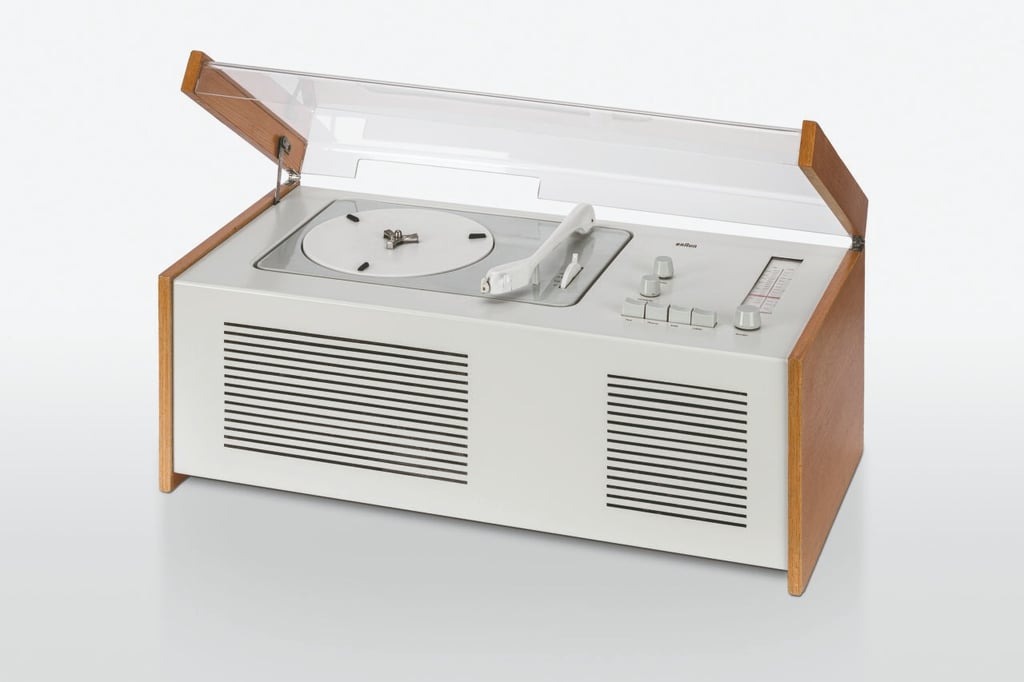
In 1958, Dieter Rams designed a record player for Braun.
The SK4 — nicknamed Snow White's Coffin by the German press for its clear acrylic lid and white lacquered body — was unlike any consumer electronics product that had existed before it. Where radios and record players of the era were designed to look like furniture, to blend into domestic environments through fussy ornamentation and warm wood tones, the SK4 declared itself an object. A designed thing, unashamed of its function, presenting its mechanism honestly through a transparent cover rather than hiding it behind decorative cabinetry.
Forty-seven years later, Jony Ive at Apple designed the iMac G4 with a transparent enclosure that revealed its internal mechanics. Then the iPhone. Then the entire visual language of the company that became the most valuable corporation on earth.
Ive has said, directly and repeatedly, that Dieter Rams was the primary influence on everything he designed at Apple. The documentary about Rams's work is called — at Ive's suggestion — Rams.
Almost nobody who uses an iPhone knows this name.
The Ten Principles
In the late 1970s, concerned that the design world was producing too much and thinking too little, Dieter Rams articulated ten principles for what he called good design. They have since been reproduced, referenced, and taught in design schools on every continent, and they remain the most concise and useful framework for thinking about objects that exists.
Good design is innovative. Good design makes a product useful. Good design is aesthetic. Good design makes a product understandable. Good design is unobtrusive. Good design is honest. Good design is long-lasting. Good design is thorough down to the last detail. Good design is environmentally friendly. And the tenth principle, the one that contains all the others: good design is as little design as possible.
Less but better. That's the distillation. It sounds simple enough to dismiss until you try to apply it and discover how difficult restraint actually is — how much easier it is to add than to subtract, to complicate than to clarify, to make something impressive than to make something right.
Rams spent his career at Braun proving that restraint is not a limitation but a discipline, and that discipline, applied with intelligence and conviction, produces objects that outlast everything designed without it.
The Objects
The catalog of objects Rams designed at Braun between 1955 and 1995 is staggering in its coherence. Shavers and radios and calculators and coffee makers and hi-fi systems, each one expressing the same philosophy in a different application. The T3 pocket radio of 1958, a rectangle of white plastic with a circular speaker grille, looks like the reference image from which the original iPod was traced. The ET66 calculator of 1987 — clean grid of keys, clear typographic hierarchy — was the direct visual inspiration for the iPhone calculator app that shipped in 2007.
These are not coincidences. Ive studied Rams's work systematically. Apple's design language is, in significant part, a digital translation of principles Rams developed in analog objects four decades earlier.
The irony that Rams, who spent his career arguing for restraint over obsolescence and against the culture of constant replacement, became the philosophical foundation for the company that industrialized annual product cycles is not lost on people who know his work. Rams himself has noted it.
Why He Belongs Here
The FlyAssLife argument for Dieter Rams is not primarily about design. It is about a man who spent his entire career in service of a single idea — that the purpose of a designed object is to serve the person using it, quietly and completely, without calling attention to itself — and who held that idea against every commercial pressure to do otherwise.
Braun's marketing departments wanted more. More features, more visual complexity, more reasons to upgrade. Rams resisted consistently. His argument was that an object designed to last, to remain useful and beautiful over decades rather than seasons, was a more honest product than one engineered for obsolescence.
He was right. The objects he designed in the 1950s and 1960s are still considered beautiful. They sit in the permanent collections of MoMA and the Vitra Design Museum. They are reproduced and referenced and studied. The objects designed to replace them have been replaced again and again and are now landfill.
"Less but better" is not a design principle. It is a philosophy for living. Rams spent his life proving it in plastic and metal. FlyAssLife has been making the same argument in a different language.
The Culture is FlyAssLife's lens on the art, music, and creators who define what fly actually looks like.
#FlyAssLife
Reach out on our socials @FlyAssLife. Embrace living the #FlyAssLife.
Contact
join flyasslife. no spam, just the good stuff.
will@flyasslife.com
©FlyAssLife 2026. All rights reserved.